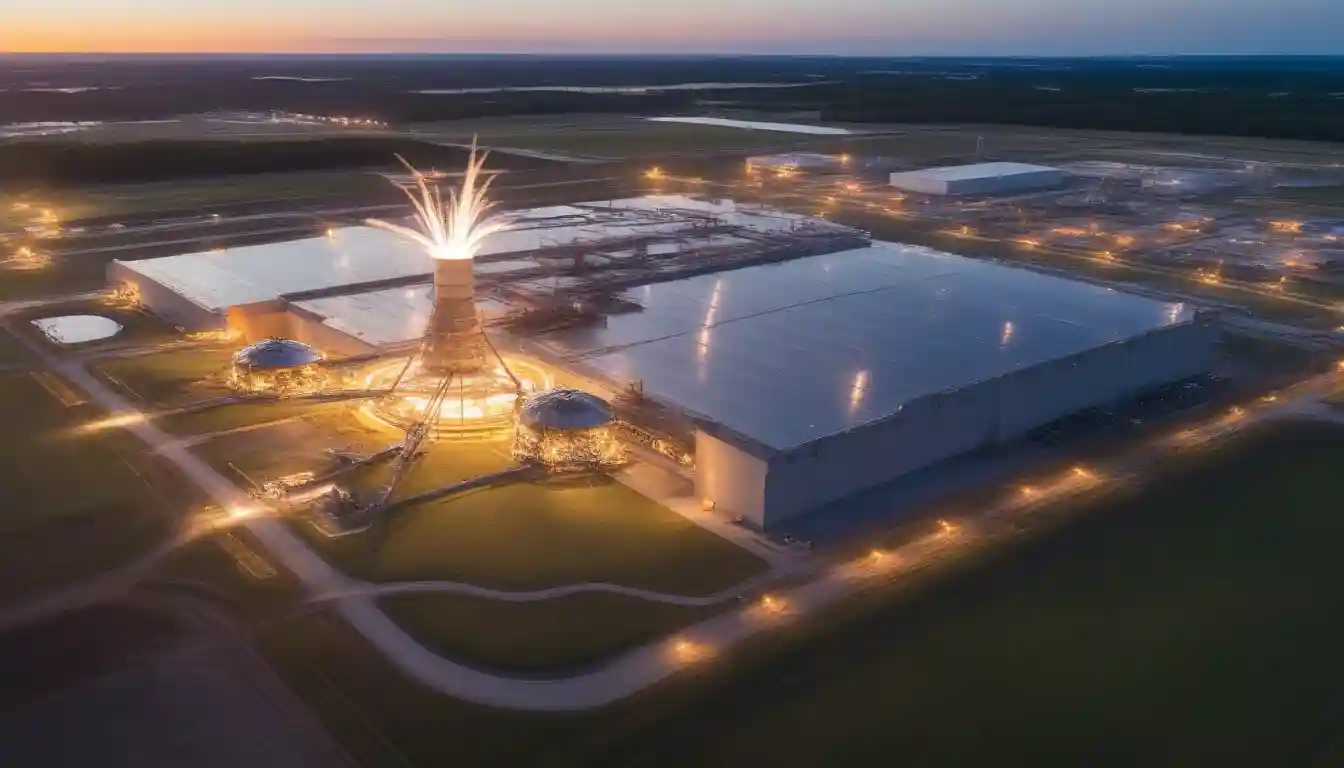
Nuclear Startup Antares Raises $96 Million to Demonstrate Reactor by Mid-2026 as Military Demand Reshapes Industry
Nuclear Startup's Breakneck Timeline Tests Industry's New Reality
Antares Industries' $96 million raise crystallizes a fundamental shift: America is attempting to rebuild nuclear capacity not through utilities, but through defense contracts and venture capital
Antares Industries closed a $96 million Series B today with a promise that would have seemed fantastical five years ago: a nuclear reactor reaching criticality by July 4, 2026—less than two years from the company's founding. The Torrance-based startup joins a cohort of more than a dozen firms racing to demonstrate small nuclear reactors under an executive order that bypasses traditional Nuclear Regulatory Commission pathways, replacing decades-long approval processes with Department of Energy authorizations measured in months.
The funding round, led by Shine Capital with $71 million in equity and $25 million in debt, targets hardware most nuclear engineers haven't touched in their careers: sodium heat pipes, HALEU fuel fabrication, and closed Brayton cycle turbomachinery. CEO Jordan Bramble's announcement frames the capital as operational, not aspirational—facility expansions across three states, equipment procurement, and a low-power Mark-0 demonstration at Idaho National Laboratory by mid-2026, followed by a full-power prototype in 2027.
This acceleration reflects restructured federal demand more than technological breakthrough. The Army's JANUS program, announced in October, commits to microreactors on nine bases by 2030. NASA's Fission Surface Power program targets a 100-kilowatt reactor on the lunar surface by decade's end. Both align precisely with Antares' 100-kilowatt-to-1-megawatt R1 design—a sodium-cooled, TRISO-fueled system optimized for transportability and unattended operation rather than grid-scale generation.
The competitive field is crowded and well-capitalized. Radiant Nuclear secured $165 million in May for its 1-megawatt Kaleidos unit and already holds a military base contract. X-energy closed a $700 million round for 80-megawatt reactors destined for Amazon data centers. Aalo Atomics raised $100 million in August targeting criticality by the same July 2026 deadline. All eleven firms in the DOE's Reactor Pilot Program are chasing variants of the same thesis: that modularity, factory production, and iterative testing can compress nuclear timelines from decades to years.
Military Demand Reshapes Nuclear Economics
The commercial logic underpinning these ventures inverts traditional nuclear finance. Large reactors required multi-billion-dollar utility commitments and decade-long construction, creating capital risk that killed projects when natural gas prices collapsed or local opposition mobilized. Microreactors target customers willing to pay premiums for energy security—forward operating bases burning $400-per-gallon airlifted diesel, lunar habitats with no alternative, submarines requiring megawatts in confined spaces.
This military-industrial pathway circumvents the three factors that paralyzed U.S. nuclear development after Three Mile Island: regulatory accretion that ballooned licensing documentation beyond 100,000 pages per plant, wholesale electricity markets favoring cheap gas over capital-intensive baseload, and political opposition that stalled waste management solutions. Executive Order 14301, signed in May 2025, explicitly prioritizes national security and economic competitiveness in nuclear decisions, directing DOE to authorize test reactors and NRC to streamline licensing for defense-critical designs.
The policy engineering is transparent. JANUS contracts will be structured as milestone-based public-private partnerships with commercial ownership, creating reference deployments that de-risk later civilian sales. HALEU fuel allocations from DOE—Antares received one in August—bypass market development bottlenecks. The DOE pilot program's July 4, 2026 deadline creates forcing functions that traditional NRC processes never imposed.
Whether this constitutes genuine nuclear renaissance or subsidized niche manufacturing remains contested. Global nuclear investment projections have surged to $2.2 trillion through 2050, up 47% from prior forecasts, driven partly by data center energy demand expected to double by 2030. But microreactors occupy a distinct segment: Defense analysts estimate JANUS might deploy 10-20 units across all competitors by 2030—proof points rather than scale. Broader adoption depends on cost trajectories currently hidden behind defense classification and on NRC eventually accepting DOE test data for commercial licensing.
Asymmetric Bet on Policy-Engineered Market
For institutional investors, Antares represents a test of whether venture capital mechanics can succeed in markets traditionally dominated by utilities, contractors, and government cost-plus structures. The Series B valuation remains undisclosed, but comparable rounds in the sector suggest post-money valuations between $300 million and $600 million for companies at similar stages.
The bull case centers on oligopoly economics in a protected market. If R1 becomes the standard solution for specific defense profiles—undersea surveillance, Arctic bases, expeditionary radar—even 30-50 units deployed by 2040 could generate cumulative revenues exceeding $3 billion at estimated unit economics of $80-200 million per system. Manufacturing at the company's targeted 10 units per year from its 145,000-square-foot facility would create defensible supply chain moats in a HALEU-constrained environment where only limited domestic production exists.
The structural advantage lies in multi-domain applicability. Antares' design explicitly targets land, sea, underwater, and space—matching NASA's closed Brayton cycle specification for lunar power while simultaneously addressing Army installation requirements. Competitors typically optimize for one domain. Radiant's Kaleidos emphasizes rapid deployment for base power. X-energy's Xe-100 serves grid-adjacent industrial customers. Aalo targets data centers. Only Westinghouse's eVinci—backed by an established nuclear contractor—competes directly across mission profiles, but incumbents historically lack the iteration speed that venture-backed firms can achieve under compressed timelines.
Risk factors cluster around execution and policy durability. Nuclear projects routinely overrun schedules—NuScale's pioneering small modular reactor suffered 20% cost increases and deployment delays. Antares' 2026 criticality timeline assumes flawless hardware integration of heat pipe cooling systems, which have limited operational heritage at multi-decade lifetimes, and Brayton turbomachinery requiring precise thermal management. HALEU fuel supply depends on production capacity that remains nascent. The DOE pathway avoids NRC for demonstrations but not for scaled commercial deployment, where regulatory acceptance of passive safety claims remains uncertain.
The capital structure compounds risk. Nuclear manufacturing is asset-intensive—facility build-outs, fuel fabrication capability, and prototype construction will exhaust the $96 million within 18-24 months even if technical milestones proceed smoothly. X-energy's path to $1.4 billion in total funding and Radiant's progression to $225 million indicate that Series B investors should anticipate at least one additional large round, likely at higher valuations if 2026 demonstrations succeed but with substantial dilution risk if they slip.
Investor diligence should focus on the signed DOE authorization agreement governing the 2026 test, detailed probabilistic risk assessments for transport and battle damage scenarios, and transparency on JANUS down-select processes. The distinction between being one of eleven pilot participants and becoming one of two or three production contractors will determine whether returns are modest or fund-defining.
Execution Gauntlet Looms
The 2026 deadline imposes discipline that venture-backed nuclear has never faced. Success requires validating reactor physics, demonstrating control systems, proving heat pipe reliability, and establishing operational procedures—all within an 18-month window that leaves minimal margin for redesign cycles. Peers including Oklo, Deep Fission, and Terrestrial Energy face identical constraints under the same DOE pilot.
Historical nuclear development offers cautionary precedent. The United States constructed over 100 reactors between 1960 and 1990 but has completed only one—the troubled Vogtle plant—since 2016. Cost overruns at Vogtle exceeded $30 billion. Even France's standardized program, often cited as the successful counterfactual, required decades and state backing to achieve efficiency. Antares and its competitors are attempting to compress that learning into initial demonstrations measured in months.
The broader ecosystem's health depends on multiple firms reaching criticality successfully. A single high-profile failure could trigger political backlash that reverses the executive order regime, particularly if safety incidents occur during accelerated testing. Conversely, if three or four demonstrations succeed by late 2026, the validation could unlock subsequent commercial and international opportunities that justify current valuations.
For an industry that lost the ability to build iteratively—where entire engineering generations retired without operating the hardware they designed—the coming 18 months will determine whether policy reform and venture discipline can genuinely restore American nuclear capacity or whether the fundamental challenges of atom-splitting remain resistant to startup methodologies. Antares' Mark-0 demonstration will provide one decisive data point in that referendum.
NOT INVESTMENT ADVICE