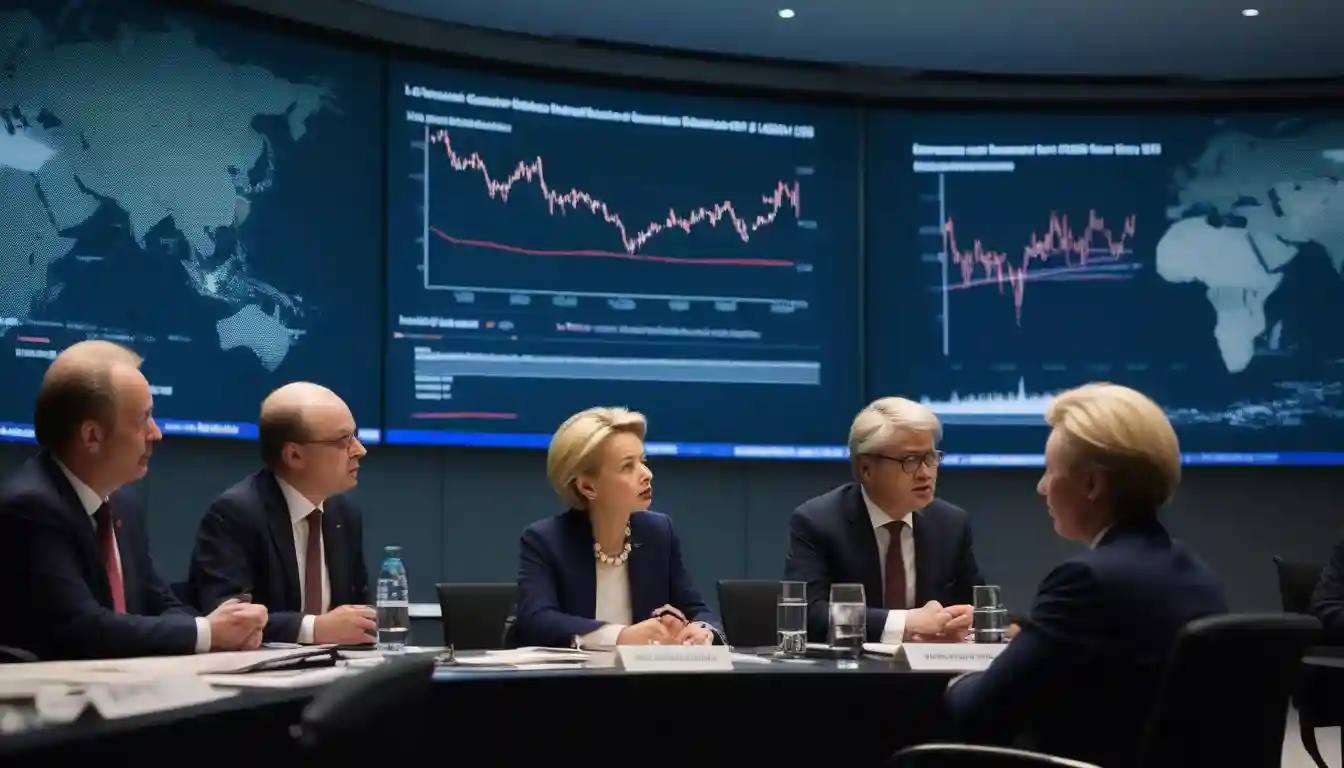
Hormuz closure adds €127 billion to Europe's fuel bill, von der Leyen says
Ursula von der Leyen says the closure added €127 billion to Europe's fossil fuel import bill. Higher global energy prices could leave European industry with a lasting cost disadvantage.
European Commission President Ursula von der Leyen said on November 3 that Europe's fossil-fuel import bill had risen by an estimated €127 billion. She attributed the increase to the Strait of Hormuz closure and said the expenditure bought no additional energy.
That is a political estimate, not an audited EU budget expense or a measured loss of industrial output. Its underlying calculation is not established by the reported statement.
The economic warning is nevertheless substantial. Europe need not import fuel directly through Hormuz to suffer from its disruption. Globally traded oil and liquefied natural gas (LNG) become more expensive when supply contracts, transport risks rise and buyers compete for alternative cargoes.
The result is a potential competitiveness tax: higher costs without corresponding gains in productive capacity.
What the €127 billion measures
In remarks reported by ANSA, von der Leyen attributed €127 billion of additional fossil fuel import expenditure to the closure.
The distinction matters. Additional import spending is not equivalent to €127 billion in lost GDP, corporate profits or public funds.
A rigorous calculation would compare actual import prices and quantities with what Europe would otherwise have paid and imported. The reported figure does not disclose that counterfactual, its precise accounting period or its treatment of changing volumes.
The European Commission's April estimate put additional energy import costs at €24 billion.
The November estimate is much larger, but the announcements cannot be treated as a reconciled statistical series without consistent definitions and methodology. Subtracting them would not establish verified incremental expenditure.
Nor does the larger figure prove that every additional euro resulted exclusively from disrupted physical shipments. Global price expectations, alternative sourcing and changes in demand complicate attribution.
The cost reaches factories in layers
The first channel is global repricing.
Disrupted Gulf supply can increase competition for available oil and LNG. Longer voyages, freight charges and war-risk insurance can raise delivered costs even when replacement energy arrives.
The second channel is industrial production.
Gas prices influence European electricity costs. Chemical producers, foundries and glass manufacturers face higher operating expenses where energy contracts expose them to the shock.
Margins narrow when those costs rise faster than selling prices. Companies with fixed-price energy contracts, hedges or lower gas dependence may fare better.
The third channel is finance.
If higher energy costs sustain inflation, they can reduce central banks' room to ease monetary policy. Borrowing and working-capital costs may therefore remain elevated while manufacturers finance more expensive inputs.
The Commission's Joint Research Centre modelled a prolonged disruption with fourth-quarter oil near $180 a barrel, versus $84.7 in its baseline. European gas was modelled near €80 per megawatt-hour, versus €42.2.
The European Commission's Joint Research Centre model put fourth-quarter 2026 oil at $84.7 per barrel in its baseline and around $180 under a prolonged Strait of Hormuz disruption.
View data
| Scenario | Oil price (USD/barrel) |
|---|---|
| Baseline | 84.7 |
| Prolonged Hormuz disruption | 180 |
These are stress-test assumptions, not verified November market prices.
The comparison matters because it illustrates potential input-cost exposure under prolonged disruption, but the modelled prices and factory-level effects remain unconfirmed.
There is also a fourth effect: demand destruction. A manufacturer that cuts production buys less energy, potentially reducing the import bill while losing output and revenue.
Lower energy expenditure therefore need not mean economic recovery.
Europe is paying for resilience
The EU temporary state aid framework identifies direct effects on oil, gas, fertilisers and electricity and permits support measures responding to the disruption.
Relief can protect industrial cash flow. It cannot itself restore physical supply or eliminate the underlying transport premium.
Instead, governments may absorb part of the burden that would otherwise fall on companies and households.
The EU energy regulator ACER estimates that a full-year closure could produce a global LNG supply shortfall of 27 billion cubic metres.
That is a conditional estimate, not an observed annual deficit. If realised, it would intensify competition for replacement cargoes.
The strategic comparison is between two forms of spending.
Emergency support pays to preserve existing production through a disruption. Investment in grids, storage, generation and electrification seeks to reduce exposure to future imported-fuel shocks.
The second approach requires upfront capital and time. It does not automatically lower today's energy bill.
Distribution matters equally. Long-term contracts may insulate one buyer while another pays spot-market prices. An energy-intensive factory with limited pricing power can suffer margin compression even when the wider economy absorbs the shock.
This is why €127 billion is a useful indicator of exposure but a poor standalone forecast of corporate earnings.
Possible outcomes
The base case is persistent but uneven pressure.
CTOL expects Europe's energy import premium to remain above its pre-closure baseline through the first half of 2027.
Under this scenario, energy-intensive producers remain exposed through the heating season, while contracts, hedges and fuel mix determine which companies absorb the largest costs.
The evidence to watch is sustained elevated delivered oil and gas costs relative to the earlier baseline.
An alternative is faster substitution.
If governments and utilities move from temporary relief toward approved grid, generation and storage investments, Europe could reduce future exposure to imported-fuel disruptions.
The evidence to watch is approved investment progressing into implementation, rather than announcements alone.
This would strengthen medium-term resilience without necessarily removing the near-term premium.
The downside is supply disruption becomes production disruption.
A further supply shock before alternative routes and storage recover could intensify price pressure and force energy-intensive manufacturers to curtail output.
The evidence would be sustained energy-cost increases accompanied by industrial production cuts.
The base-case call fails if safe navigation returns and European oil and gas prices settle back to their earlier baselines within two months.
A further challenge to the structural-risk thesis would be normalised delivered costs without continuing industrial margin pressure.
Evidence to watch
The next Commission energy forecast and ACER market update are essential tests, but neither should be assumed to validate the €127 billion calculation automatically.
Three pieces of evidence matter: a transparent import-bill counterfactual, observed delivered energy prices relative to baseline, and industrial output and margin responses.
Together, they would help distinguish a temporary terms-of-trade shock from a persistent competitiveness disadvantage.
If import prices normalise while industrial production stabilises, the case for a lasting penalty weakens. If delivered costs remain elevated and manufacturers continue cutting output or absorbing higher inputs, the structural interpretation strengthens.
For European industry, energy security has become part of the margin model.
The decisive question is not simply whether fuel reaches Europe. It is whether companies can obtain it reliably at prices that preserve their ability to compete.