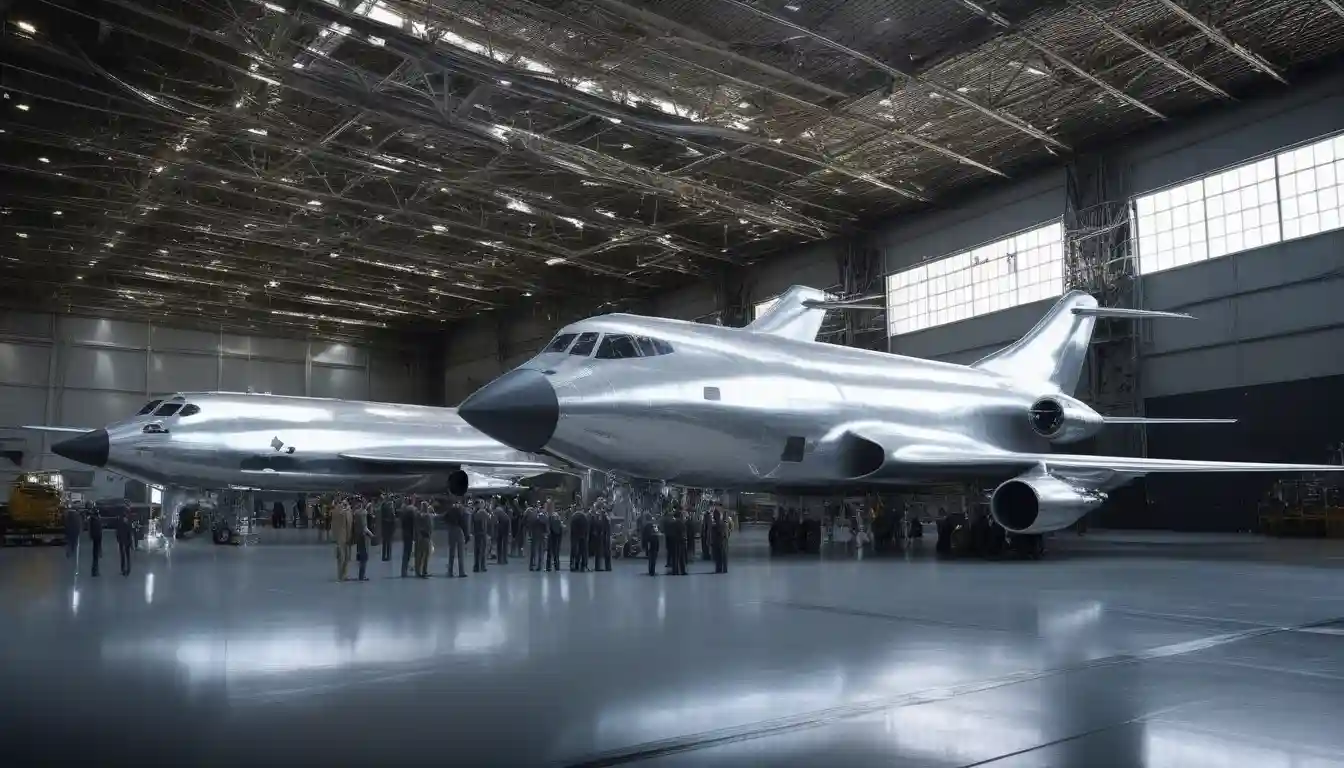
USAF Unmanned Tanker Talk Hides a Bigger Shift: NGAS Is Dead and the KC-46 Wins the 2030s
The head of Air Mobility Command says the next tanker need not carry a crew. The acquisition chief has ended the new-airframe effort, and the 2027 budget gives "advanced tanker systems" $13 million against $3.9 billion for KC-46s. Pilotless mega-tankers are a 2040s idea; the next decade's money goes to Boeing jets and the kit that protects them.
The general who runs the Air Force's tanker fleet told reporters this month that its next refuelling aircraft may not need a pilot. The remark made a good conference line, but had no programme behind it. The same week, the service's acquisition chief said the Air Force would not build a new tanker airframe at all, crewed or otherwise. For the next decade, the tanker money goes to more Boeing KC-46s and to the sensors, jammers and datalinks that keep them alive. The procurement opportunity therefore sits with Boeing, which is still losing money on the programme.
Lt. Gen. Daniel Tulley, who took over Air Mobility Command in August, made the remarks at the Air & Space Forces Association conference in National Harbor, Maryland. "I do not believe that it has to be a manned future air refueling solution," he said, pointing to the Navy's MQ-25 Stingray. He then described the problem himself: an uncrewed tanker with the range the Air Force needs "is a very large aircraft," and nobody yet flies large aircraft fully autonomously. Air & Space Forces Magazine and Defense One carried the remarks.
At the same conference, William Bailey, the Air Force's acquisition chief, said the service would focus on survivability instead. Industry proposals for a survivable Next Generation Air Refueling System looked like "an incremental improvement," he said, and the service will "go after how to make the tanker survivable" with protective systems around existing aircraft. Defense Daily reported that the new-airframe effort has ended. A year ago the plan was to bring NGAS forward from 2040 to 2036. That plan has now been dropped.
The budget confirms the shift. The Air Force spent $12 million this year studying a new tanker, zeroed that line in its 2027 request and asked for $13 million for "advanced tanker systems." In the same request it wants $3.9 billion for 15 more KC-46s. The future-tanker line is about a third of one percent of the Boeing buy. That is a study budget, and it tells you where the programme stands better than anything said on a conference stage.
The MQ-25 shows the scale problem. The Navy's drone first flew in April, cleared Milestone C in May and won a $562 million first production contract on September 14 covering three aircraft plus long-lead parts for three more. Deliveries start in 2029. The aircraft passes about 14,000 pounds of fuel to a Super Hornet 500 miles from its carrier. A KC-46 carries 212,000 pounds, roughly 15 times as much, across ocean distances. It took the Navy more than a decade to get a carrier drone of this size into production. Nothing in that record suggests the Air Force can field an autonomous aircraft of 767 size before the mid-2040s.
The war with Iran creates a case for autonomy. Tankers took the heaviest losses of any American manned fleet: two KC-135s destroyed and up to seven damaged, according to The War Zone's tally. Six crew died when one went down in western Iraq in March after a mid-air collision. The Pacific would be worse. Chinese long-range missiles are built to reach the slow, unarmed aircraft that American fighters depend on. That makes a case for taking crews out of harm's way, and doing it quickly.
The losses point to a different conclusion. The fatal crash was a collision, and other aircraft were damaged by Iranian strikes on a Saudi air base while parked. Removing the pilot from a jet parked on a ramp within missile range changes nothing about its survival. A pilotless aircraft of the same size is as easy for Chinese radar to find as a crewed one, and costs close to as much to replace. Tanker survival in a Pacific war depends on dispersal, base defence, self-protection and the number of airframes available. Bailey's plan addresses all four. The fastest way to get more airframes is a production line that already runs.
The fleet numbers sharpen the point. In March the Air Force had about 373 KC-135s and 103 KC-46s, 476 tankers against a statutory floor of 466. War losses and battle damage have since eaten into that margin. The Pentagon's news service has reported that even after the last contracted KC-46 arrives, the remaining KC-135s will average 67 years old. "The last KC-135 pilot has not been born," Maj. Gen. Gerald Donohue, AMC's deputy commander, said at the same conference. The fleet cannot wait for an aircraft that exists only as a slide.
Boeing therefore has a monopoly it did not bid for. The Air Force plans 188 KC-46s by 2030 and 263 in total once the 75-aircraft extension is signed. Negotiations stalled over deficiencies until a May agreement to fix them. The Air Force has also raised the ceiling on the export contract to $19.1 billion to cover Japan and Israel, and Qatar has approval for four aircraft worth $4.5 billion. Boeing has written off more than $7 billion on the fixed-price development deal, including a $565 million charge in January. The extension lots are where it finally gets to price for profit, and for Boeing's defence margins that matters more than anything said about drones at the conference.
The autonomy money is real, but it goes to retrofits. Merlin Labs, which holds a Special Operations Command contract to put its autopilot on the C-130J and an Air Force agreement covering the KC-135, pitches autonomy as software added to aircraft with crews still on board. Chief executive Matthew George said at the same show that certification is the gating item and that his company is working on it with the Air Force this year. JetZero's blended-wing demonstrator, backed by a $235 million Air Force contract and built with Northrop Grumman's Scaled Composites, is due to fly in late 2027. It is the closest thing the service has to a new tanker shape. With NGAS gone, it becomes a technology demonstrator without a purchase order waiting behind it.
What the Air Force does next matters more than what its generals say. We expect the 75-aircraft KC-46 extension to be signed before the end of the first quarter of 2027. The service's 2028 budget request, due next spring, should contain money for tanker defensive systems and connectivity and no line for an uncrewed tanker programme. The first sign that the pilotless-tanker idea has become a programme would be a funded Merlin flight on a KC-135 without a crew. That will not happen before 2028. Until then, the tanker trade runs through Boeing's St. Louis and Everett lines, and through the electronic-warfare suppliers that will be asked to armour a 1950s airframe and its 767-based replacement for another twenty years.